 |
How Northeast flooding revealed the systematic collapse of American resilience
The water tells the truth that politicians won’t.
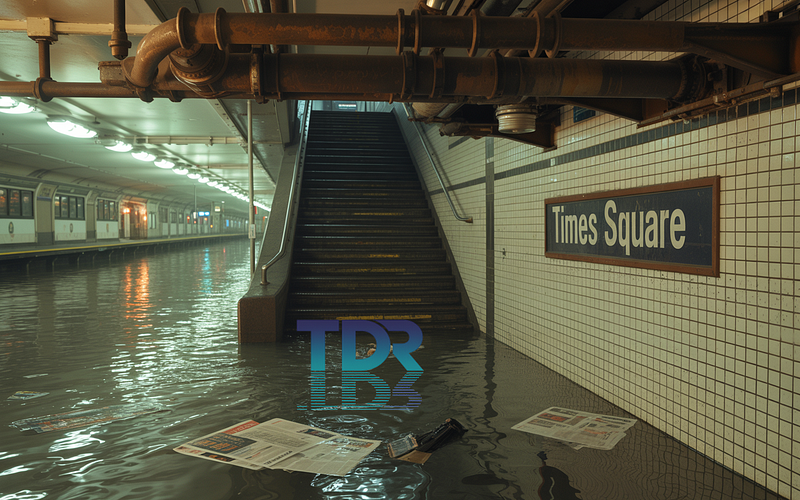
Yesterday’s flooding across New Jersey, New York, and Pennsylvania wasn’t just another weather event. It was America’s infrastructure failure laid bare, a cascading collapse that killed two people and exposed decades of deferred maintenance, climate denial, and institutional negligence.
As subway stations flooded and airports shut down, one fact became undeniable: America has built a civilization that cannot survive the climate it has created.
The Numbers Don’t Lie
While rescue teams pulled 21 people from floodwaters in New Jersey alone, the broader statistics paint an even grimmer picture. The number of flood deaths has ticked up in recent years, with 145 flood related fatalities reported in 2024, well above the 25 year average of 85 per year.
This isn’t random bad luck. It’s predictable systemic failure.
Newark Liberty International Airport reported groundings, delays, and disruptions that stranded thousands. New Jersey Transit experienced “severe impacts” that paralyzed commuter rail services. The fundamental systems that millions depend on daily proved incapable of handling weather that climate scientists have been predicting for decades.
The pattern is accelerating. Less than two weeks after flooding killed more than 130 people in central Texas, the Northeast experienced similar disasters. The common thread isn’t geographic bad luck. It’s infrastructure designed for a climate that no longer exists.
The Climate Reality Check
Daniel Swain, a climate scientist at the University of California Agriculture and Natural Resources, explains what every engineer should know but every politician ignores: “The intensity and frequency of extreme flooding events are on the rise across the United States and are likely to worsen in the years ahead.”
This isn’t opinion. It’s physics.
Warmer air holds more water. The Gulf of Mexico, which feeds moisture into weather systems affecting both Texas and the Northeast, has become significantly warmer due to climate change. This produces more evaporation, releasing tropical moisture into the atmosphere at levels never seen historically.
When that moisture encounters weather fronts, the results are “rain bombs” that dump unfathomable amounts of water in hours rather than days. Infrastructure built for historical rainfall patterns becomes obsolete overnight.
Yet America continues building and maintaining systems as if the climate of the 1950s will return.
The Cascade of Institutional Failure
Yesterday’s Northeast flooding revealed how interconnected infrastructure failures amplify into regional catastrophes. When subway systems flood, people can’t evacuate. When airports shut down, emergency resources can’t arrive. When power grids fail, communication systems collapse.
This cascading failure pattern appears in every major climate disaster, from Hurricane Katrina to the Texas winter storm of 2021. Yet American infrastructure policy continues treating these systems as independent rather than interconnected.
The problem runs deeper than aging pipes and bridges. It’s the systematic refusal to acknowledge that climate change demands fundamental rethinking of how infrastructure functions.
Consider flood maps. The Federal Emergency Management Agency updates flood risk assessments that are supposed to guide construction and emergency planning. But many of these maps date back to the 1970s and none account for current climate realities.
Private organizations like the First Street Foundation have developed updated flood models that incorporate climate change projections. Their maps consistently show far higher risk levels than official government assessments. Yet government agencies continue using outdated data because updating would require admitting that previous policies were inadequate.
The Political Economy of Denial
Infrastructure failure isn’t just technical incompetence. It’s the logical result of political systems that reward short-term thinking and punish long-term planning.
Repairing a bridge generates fewer votes than cutting taxes. Updating flood management systems is invisible until they fail. Climate adaptation investments prevent disasters that politicians can then claim never would have happened anyway.
This creates perverse incentives where the safest political strategy is to ignore predictable problems until they become unpredictable crises.
The Trump administration has accelerated this dynamic by systematically eliminating the expertise necessary to plan climate adaptation. When eight of 122 National Weather Service offices can no longer operate around the clock, early warning systems fail. When climate scientists get fired, risk assessments become political documents rather than scientific analyses.
The result is infrastructure policy based on wishful thinking rather than engineering reality.
The International Comparison
While America’s infrastructure fails during predictable weather events, other developed nations are building resilience into their systems.
The Netherlands, which sits largely below sea level, has invested billions in flood management systems that can handle climate change projections through 2100. Their “Room for the River” program gives rivers space to flood safely rather than trying to contain them with aging levees.
Japan has built tsunami early warning systems and earthquake-resistant infrastructure that saved hundreds of thousands of lives during the 2011 disaster. Their investment in resilience infrastructure pays dividends every time nature tests their systems.
Even developing nations are outpacing American climate adaptation. Bangladesh, one of the world’s poorest countries, has built cyclone shelters and early warning systems that have reduced flood deaths by 98% since the 1970s.
America, the world’s wealthiest nation, loses more people to floods every year.
The Multiplier Effect
Infrastructure failure doesn’t just kill people during disasters. It creates economic cascades that persist for years.
When subway systems flood regularly, businesses relocate. When airports experience frequent weather-related shutdowns, supply chains reroute around unreliable nodes. When power grids fail predictably, data centers and manufacturing move to more reliable regions.
Each infrastructure failure makes the next one more likely and more damaging. As systems degrade, they become more vulnerable to disruption. As disruptions increase, maintenance gets deferred to pay for emergency repairs. As maintenance gets deferred, systems degrade further.
This death spiral characterizes American infrastructure across sectors. The American Society of Civil Engineers gives U.S. infrastructure a grade of C minus, estimating that $2.6 trillion in investment is needed just to bring systems to adequate condition.
Climate change will make that number much higher.
The False Choice
Politicians often frame infrastructure investment as a choice between economic growth and environmental protection. This is backwards.
Climate-adapted infrastructure is economic infrastructure. Flood-resistant transportation systems keep commerce moving during extreme weather. Resilient power grids prevent economic shutdowns. Updated water systems prevent public health crises that cost billions in emergency response.
The Netherlands doesn’t invest in flood protection to save polar bears. They invest because flooding would destroy their economy.
American politicians who oppose climate adaptation aren’t protecting economic interests. They’re ensuring economic catastrophe.
The Window Closes
Every infrastructure decision made today will shape American resilience for decades. Bridges built to 1970s flood standards will fail repeatedly as weather intensifies. Power grids designed for historical temperature ranges will collapse during heat waves. Transportation systems that ignore sea level rise will be permanently submerged.
The window for orderly adaptation is closing rapidly. Each year of delay makes eventual adaptation more expensive and less effective.
The Northeast flooding represents a preview of America’s climate future: predictable disasters treated as unexpected emergencies, systematic failures blamed on bad luck, and preventable deaths accepted as inevitable.
The Choice
America faces a binary choice: invest in climate-adapted infrastructure or accept permanent crisis as the new normal.
The technical solutions exist. The financial resources exist. What’s missing is political will to acknowledge that the climate has changed and infrastructure must change with it.
Yesterday’s floods in the Northeast will be followed by more floods, more heat waves, more storms. The question isn’t whether these events will continue. The question is whether America will build systems capable of handling them.
The water doesn’t care about political ideology. It flows according to physics, not polling.
Infrastructure built for a stable climate will fail in an unstable one. Infrastructure built for past weather will be destroyed by future weather.
The choice is adaptation or collapse.
Nature has already voted.
The question is whether democracy can do the same.
The Daily Reflection cuts through the noise to find the stories that actually matter. Follow for thoughtful takes on politics, technology, and whatever’s shaping our world.


Comments
Post a Comment
Join the conversation! Share your thoughts on today's analysis. Please keep comments respectful and on-topic.