 |
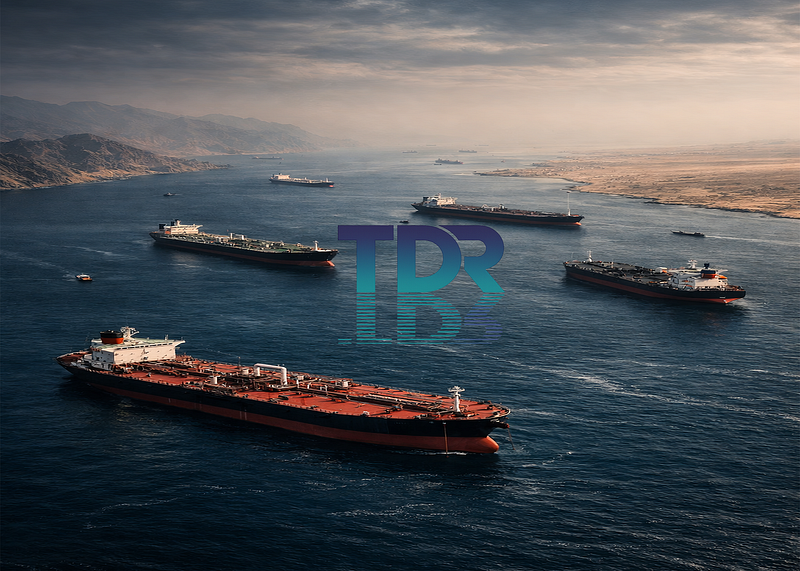
| Oil tankers sit frozen in the Strait of Hormuz, where a narrow waterway can shake the entire global economy. One chokepoint, millions of barrels, and rising geopolitical risk. This is what an energy crisis looks like from above. |
21% of the World’s Oil Is Held Hostage: The Strait of Hormuz and the War That Could Reshape Civilization’s Energy Future
Four weeks into the U.S. and Israeli war with Iran, an 18-mile waterway is holding the global economy hostage. Here is what is happening, why it matters, and what comes next.
The war with Iran just entered dangerous new territory. Not because of troop casualties or missile exchanges, but because Iranian commanders looked at the mouth of the Persian Gulf and said something the global economy has never heard before: “Not one litre of oil will pass through the Strait of Hormuz.”
That vow, spoken by an Islamic Revolutionary Guard Corps commander, is now the most consequential threat in global economics. The Strait of Hormuz, an 18-mile-wide chokepoint through which roughly 21 percent of the world’s oil and liquefied natural gas normally flows, has been effectively shut down. Shipping traffic has all but halted since the first strikes. The consequences are cascading through every economy on earth.
Brent crude surged past $103 per barrel earlier this month. Iran’s IRGC is threatening it will climb to $200. The U.S. Energy Secretary is holding daily press briefings to reassure jittery markets while quietly acknowledging that no clear plan exists to reopen the waterway. For ordinary families, the ripple effects are already visible at gas stations and grocery stores. For financial institutions, the modeling is grim: Goldman Sachs and JPMorgan economists are running recession scenarios that assume the closure extends into summer.
A New Supreme Leader and a Power Vacuum at the Worst Possible Moment
Here is what actually happened, stripped of the military jargon and political spin.
On February 28, a joint U.S. and Israeli strike on Tehran killed Supreme Leader Ali Khamenei, the figure who had governed Iran with near-absolute authority for over three decades. Within nine days, the Assembly of Experts convened and installed his son, 56-year-old Mojtaba Khamenei, as the new Supreme Leader. The succession was fast, but the legitimacy deficit was immediate and severe.
President Trump declared the selection “unacceptable.” Israel’s military issued a direct threat to target Mojtaba and any official who participated in his installation. Russia’s Vladimir Putin pledged unwavering support for the new leader. China condemned any military action against him. In the span of one week, the war reorganized the entire architecture of great-power diplomacy. The United States and Israel stood on one side. Russia and China, at least rhetorically, stood on the other. Every other nation on earth watched from the edges, calculating its exposure.
What makes the new Iranian leadership particularly dangerous is its untested nature. Mojtaba Khamenei has spent most of his life in the background of Iranian politics, cultivating influence within the IRGC but never governing at scale. The commanders who control the Strait closure are operating with considerable autonomy. There is no established back channel, no trusted intermediary, and no precedent for how this Supreme Leader behaves under maximum pressure. That uncertainty is its own form of risk.
But here is the question that matters: What happens when the people controlling the world’s most critical energy chokepoint have nothing left to lose and no reason to negotiate?
The Economics of a Closed Waterway
This is not really about Iran and Israel. It is about whether the global economy’s foundational assumption can survive contact with a war it was never designed to withstand.
The scale is staggering. Roughly 17 to 21 million barrels of crude oil pass through the Strait on a normal day, along with enormous volumes of liquefied natural gas destined for Japan, South Korea, India, and Europe. There is no realistic alternative route that can absorb that volume. Pipelines exist but are insufficient. Rerouting tankers around the Cape of Good Hope adds weeks and extraordinary cost to every shipment.
The political response has been economically extraordinary. To compensate for the supply shock, the White House quietly lifted sanctions on Russian and Venezuelan crude oil, effectively rewarding two adversarial governments in exchange for additional barrels. The strategic logic is clear: suppress prices, reduce domestic pain, buy time. The geopolitical cost is harder to calculate. A president who spent his first term tightening the vice on both Moscow and Caracas has now, in wartime, opened the spigot for both.
The message sent to every sanctions target in the world is not subtle. When the pressure is high enough, sanctions are negotiable. That signal will be read carefully in Riyadh, Beijing, Brasilia, and every other capital drawing its own conclusions about the durability of American foreign policy.
The IRGC closure exposes this logic in its rawest form. The world built its energy infrastructure on the assumption that Hormuz stays open. That assumption no longer holds.
Washington Is Fracturing From Within
While the administration projects confidence, the seams are showing.
Defense Intelligence Agency Director Joe Kent resigned this week in what sources inside the administration described as a fundamental break with the White House over the war’s direction and its underlying intelligence assessments. Kent’s departure is the most senior intelligence community defection of the conflict so far, and it has not been quietly absorbed. Congressional oversight committees are demanding briefings. The intelligence community is visibly unsettled.
Meanwhile, the military posture is generating its own contradictions. Thousands of Marines are being deployed to the Middle East theater even as Trump has repeatedly mused publicly about “winding down” U.S. military involvement. These statements are not being received as reassurances by allied governments. Japan, South Korea, India, and the entire European Union depend heavily on Gulf energy, yet none of them has been given a meaningful seat in diplomatic conversations. Their governments are watching a war unfold without their input, a conflict that will shape their economies for years, and they are growing visibly restless.
The U.S. Navy has been assigned the mission of escorting oil tankers through the region “when militarily possible.” That qualifier is doing considerable work. Iran has demonstrated, repeatedly and with precision, that it can strike Gulf energy infrastructure at will. Every escort mission is a potential flashpoint. Every tanker that gets through is a negotiating chip. Every tanker that does not is a data point in a global recession forecast.
We have built a military posture that promises protection it cannot guarantee, in a waterway that cannot be safely reopened by force alone.
What This Means for Every Economy on Earth
The 48-hour ultimatum Trump issued to Iran’s new Supreme Leader to reopen the Strait was met with a vow to keep it closed indefinitely. The U.S. military has now deployed bunker-buster munitions to the region near the Strait, raising urgent fears among allied governments of a massive escalation targeting Iran’s underground nuclear facilities.
This has profound implications far beyond energy prices. Cuba, cut off from oil for three months as a knock-on effect of the U.S. blockade strategy, has suffered its third nationwide power grid collapse this month alone. Germany, Japan, South Korea, and India will be forced to fundamentally reconsider their energy security strategies. Some of those reconsiderations were already underway after Russia’s invasion of Ukraine. The Hormuz crisis accelerates every timeline.
What makes this moment particularly dangerous is how it exposes the mythology of globalization. We were told that economic interdependence made wars too costly to sustain. We were told that supply chains would bind nations together. But when those supply chains run through a single 18-mile waterway controlled by a new and untested Supreme Leader with no back channels and nothing to prove, interdependence becomes a vulnerability, not a safeguard.
This is what civilizational risk looks like: not a dramatic nuclear exchange, but a slow strangulation of the arteries that carry the world’s energy. A navy that can escort but cannot guarantee. A president who issues ultimatums that go unanswered. An intelligence community defecting in real time.
The Human Cost Nobody Is Tallying
While strategists model recession scenarios and traders watch oil futures, actual people are making impossible choices. Families in Japan and South Korea face heating bills they cannot afford. Drivers in Europe stare at fuel prices that have crept toward levels not seen in decades. In America, the grocery bill has already started climbing even before the full weight of a prolonged closure has registered in the supply chain.
These costs are not hypothetical. They are accumulating now, week by week, barrel by barrel, as the world’s most important waterway sits closed and the diplomatic calendar stays empty.
History will ask what the wealthiest and most powerful nations on earth did in the weeks when they still had leverage. Whether they used the diplomatic window before bunker-busters made dialogue impossible. Whether they brought in the allies who had been shut out of the conversation. Whether they found a face-saving off-ramp for a new Supreme Leader who needed one.
The answer, so far, is that they issued ultimatums, deployed munitions, and held press briefings.
The Bottom Line
The Hormuz closure is the first sustained disruption of this critical waterway in modern history. It challenges the foundational assumption of the post-Cold War order: that global supply chains are inviolable. The fact that the United States unlocked Russian oil to compensate is a geopolitical earthquake in its own right. And the 48-hour ultimatum with bunker-busters now in the region means the next chapter could arrive before this one is even fully understood.
An 18-mile waterway. Twenty-one percent of the world’s oil. Four weeks into a war with no clear exit. The math is not complicated. The consequences are.
Welcome to the global economy in 2026, where civilization’s energy future runs through a chokepoint and nobody looks like they have a plan.
The Daily Reflection cuts through the noise to find the stories that actually matter. Follow for thoughtful takes on politics, technology, and whatever’s shaping our world.
Sources: NPR (March 21, 2026) · CNN Politics (March 20, 2026) · Al Jazeera (March 11, 2026) · NPR (March 8, 2026) · Naked Capitalism (March 2026) · NBC News (March 2026)


Comments
Post a Comment
Join the conversation! Share your thoughts on today's analysis. Please keep comments respectful and on-topic.